
Are you aware of how most AI projects falter? It is often not in the lab or the boardroom… instead, they falter in the gap between a working prototype and a product that handles real users, real data and true operational pressure without crumbling.
Closing that gap is what AI product development services exist to do. It requires data pipelines, validation harnesses, infrastructure planning, cost modelling and the kind of cross-functional coordination that cannot be automated away.
This guide covers the complete journey from ideation through production deployment, hitting every phase that end-to-end AI development has to deliver in order to return the best possible results.
What is covered by AI product development?
The term gets stretched to cover everything from a freelancer fine-tuning a chatbot to a 200-person engineering organisation managing a fleet of computer vision models in production.
Strip away the marketing and the discipline boils down to one thing: translating a business problem into an AI-powered solution that works reliably at scale and can be maintained long after the initial build team moves on.
An end-to-end engagement spans several interconnected workstreams. It starts with problem framing and data strategy, working out whether AI is actually the right tool for the job, identifying the datasets required and establishing data governance that complies with relevant regulation.
From there, work moves into model development: selecting architectures, training or fine-tuning and iterating based on evaluation metrics rather than intuition.
Model development accounts for roughly 30% of the total effort.
The other 70% is scaffolding. APIs, monitoring, retraining pipelines, access controls, cost management, user experience design and the testing infrastructure that catches failures before end users do.
Whether the product is an NLP engine, a biometric verification system or a computer vision pipeline, the engineering required to make it production-grade consistently dwarfs the work that went into training the model.
SkyBiometry’s Call2Book product makes this concrete. Call2Book handles appointment scheduling and customer service over the phone, combining NLP (STT/TTS) and real-time CRM integration. Models account for a fraction of the total system. Most of the engineering sits in the integration layer: conversational logic, real-time availability checking, monitoring and the CRM connectors that keep everything performing under live traffic.
Organisations that treat AI development as build model, deploy model, move on, accumulate technical debt faster than value. The ones that get lasting results enforce a cyclical methodology where deployment decisions are informed by production telemetry and every model update is preceded by structured validation.
The Data Layer: a foundation of every AI product
No amount of architectural sophistication compensates for poor data. AI development services that shortchange the data strategy phase are building on sand.
Four concerns make up the data layer:
- acquisition (where does the data come from and under what terms?)
- curation (how is it cleaned, labelled and versioned?)
- governance (who owns it, who can access it and what regulations apply?)
- pipeline engineering (how does it flow from source systems into training and production with minimal latency?).
Tools like Label Studio, DVC, Apache Airflow and Kubeflow Pipelines have become standard in mature pipelines, but the tooling matters less than the principle: data movement must be automated and reproducible.
Data-centric AI has gained traction as organisations discover that a well-curated dataset of modest size frequently outperforms a noisy dataset ten times larger.
For teams fine-tuning large language models, this is especially pronounced. A few hundred carefully crafted instruction-response pairs often produce better task performance than thousands of low-quality examples.
AI testing and validation: the underestimated phase
If model training is where the excitement lives, testing is where the credibility lives.
AI testing and validation remain one of the most neglected phases in the development lifecycle, yet it is the most reliable predictor of whether a model will survive contact with real-world data. A model’s behaviour is shaped by its training data and even subtle shifts in distribution can cause silent degradation that no unit test will catch.
Effective testing operates at multiple layers. Model-level evaluation measures accuracy, precision, recall, F1 score and domain-specific metrics against holdout datasets that genuinely represent production conditions.
Beyond raw accuracy, testing must also address robustness and fairness, as well as latency under realistic load. Frameworks like Evidently AI and Great Expectations provide structured approaches to these evaluations.
System-level testing confirms that the model integrates correctly with upstream data sources and downstream consumers. Regression testing catches breakages when models update. Load testing reveals performance cliffs that benchmarks miss.
For teams deploying large language models, testing around hallucination detection and output consistency is non-negotiable, alongside sensitivity testing for prompt variations. Human-in-the-loop review and red-teaming exercises have become standard practice in serious deployments.
LLM fine-tuning: when PEFT makes sense
LLMs have changed the calculus of AI product development. Rather than training task-specific models from scratch, teams now routinely start with a foundation model and adapt it through fine-tuning. The real question is how to fine-tune efficiently and whether fine-tuning is even the right approach for a given use case.
Full fine-tuning means updating every parameter in the network. For models with billions of parameters, this demands significant GPU resources and large curated datasets, plus the expertise to manage distributed training runs without destabilising the model.
Parameter-Efficient Fine-Tuning (PEFT) offers an alternative. Instead of updating the entire model, PEFT methods modify a small subset of parameters or introduce lightweight adapter layers, achieving task-specific performance at a fraction of the compute cost.
Techniques like LoRA (Low-Rank Adaptation), QLoRA, and prompt tuning have made it practical to customise large models on modest hardware using libraries like Hugging Face PEFT.
PEFT excels when the target task is a variation on capabilities the base model already possesses. When the required behaviour diverges significantly from the base model’s training distribution, or when the volume of high-quality training data is very large, full fine-tuning may still yield materially better results. The decision is an engineering trade-off involving dataset size and other key factors – all of which are explored in more detail in this article.
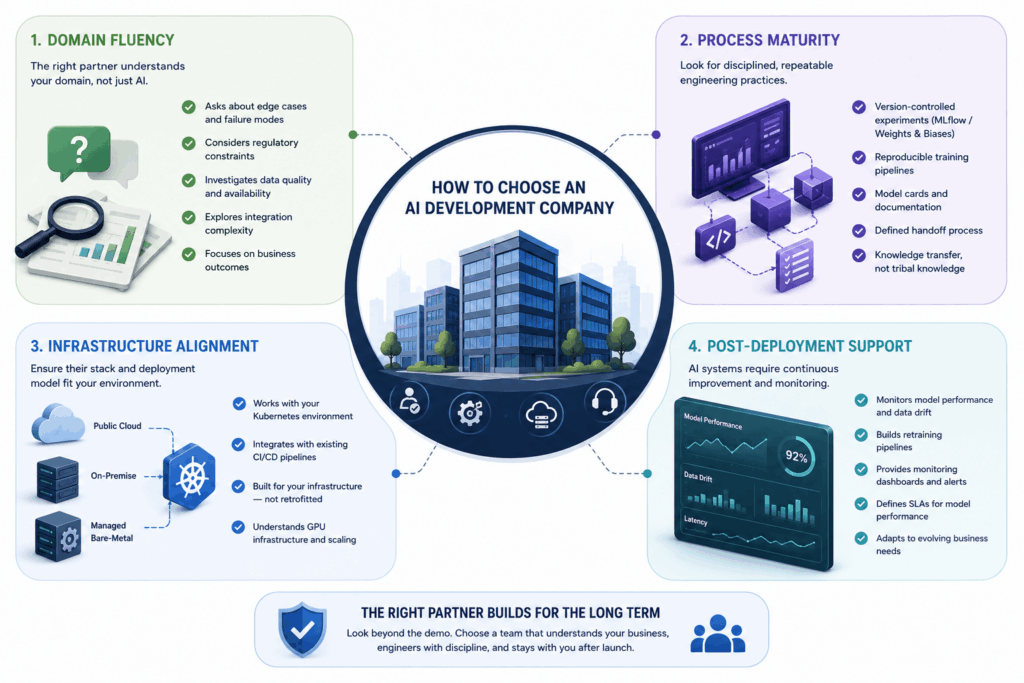
How to choose an AI development company
For organisations that lack in-house AI engineering depth, selecting the right external partner is a crucial decision within the entire project lifecycle. In a crowded market, finding a vendor that can not only build a convincing demo but also ship a production-grade system is substantial.
- Start with domain fluency – An AI development company should demonstrate familiarity with the specific problem domain, not just AI techniques in the abstract. Domain fluency shows up in the questions a vendor asks during discovery: do they probe for edge cases, regulatory constraints, data quality issues and integration complexity, or do they jump straight to model architecture discussions?
- Assess process maturity – Look for version-controlled experiments tracked in tools like MLflow or Weights & Biases, reproducible training pipelines, documented model cards and a defined handoff process that does not leave the client dependent on tribal knowledge.
- Check infrastructure alignment – Does the vendor assume public cloud, on-premise or managed bare-metal? Does their deployment pipeline work with the client’s existing Kubernetes environment or does it require a separate stack? Organisations already operating on dedicated GPU infrastructure need a partner whose engineering practices are built for that environment rather than retrofitted.
- Evaluate post-deployment support carefully – An AI development partner worth retaining will build retraining pipelines and define SLAs around model performance.
Biometric AI inference costs: a real-world case study
The economics of AI product development become sharpest when you examine a use case where inference costs directly impact whether the business model works.
SkyBiometry is owned by Neurotechnology, a globally recognised biometric technology company with decades of experience deploying mission-critical biometric systems in regulated environments worldwide.
Face recognition systems perform inference every time they process an image: detecting faces, extracting feature embeddings and matching those embeddings against an enrolled database. At low volumes, the per-inference cost barely registers. At scale, national ID programs process hundreds of thousands of individuals in a confined time period. With this, inference cost becomes a dominant line item.
Total cost depends on model architecture complexity, hardware selection (GPU versus specialised accelerators versus edge devices), batch size optimisation, image preprocessing pipeline efficiency and latency requirements that dictate whether you can trade speed for cost through model quantisation or dynamic batching.
NVIDIA Triton Inference Server has become a common choice here, handling model orchestration and dynamic batching with multi-framework support across the serving layer.
Biometric inference is especially revealing because of the tight coupling between accuracy requirements and cost. In security-critical applications, even marginal accuracy improvements demand disproportionately expensive hardware.
A model achieving 99.5% true acceptance at a given false acceptance rate might need twice the compute of one at 98.5%. For use cases governed by regulatory thresholds, such as those benchmarked through NIST evaluations, the cheaper model is simply not an option.
The result is a cost curve that breaks the assumption of linear scaling. Teams that skip inference cost modelling during planning routinely face budget overruns once the system hits production traffic.
The API and integration layer
The path from trained model to usable product runs through the API layer. How a model is exposed to consuming applications determines how easily it can be adopted, versioned, and scaled.
Design decisions at this layer include:
- Choice between RESTful and gRPC interfaces (gRPC offering significant performance advantages for high-throughput inference)
- API versioning strategy when underlying models update
- Authentication and rate limiting for inference endpoints
- Serve predictions synchronously or asynchronously depending on latency tolerance
Getting this layer right separates a model that works in isolation from a product that plugs into existing business workflows.
MLOps and production infrastructure
Deploying an AI model is where a new category of operational challenges begins.
MLOps has matured into a genuine engineering discipline, and for AI product development services, MLOps capability is the clearest signal of whether a team can deliver lasting value or only short-lived prototypes.
A minimum viable MLOps stack includes:
- Model versioning and registry (MLflow has become the standard)
- Feature stores like Feast to enforce consistency between training and inference
- Monitoring and alerting for data drift, concept drift, and latency degradation (Evidently AI, Prometheus and Grafana provide the observability layer)
- CI/CD pipelines purpose-built for models rather than traditional software, with stages for validation, shadow deployment, canary rollout and automated rollback
These same practices form the foundation for long-term AI model lifecycle management: the discipline governing how models are monitored, retrained and eventually retired as business needs evolve.
Investing in MLOps during the initial build is significantly cheaper than retrofitting it later, and the organisations that skip this step almost always pay for it.
From pilot to production: bridging the gap
The majority of AI projects never make it past the pilot stage. Why? Organisational and economic factors are as important as procedural.
A pilot succeeds in a controlled environment with curated data and dedicated engineering attention.
Production demands something harder: resilience against messy real-world data, integration with legacy systems and ongoing cost discipline as usage scales.
Cost discipline deserves particular emphasis. A common failure pattern: a pilot performs well on test traffic, goes live and immediately reveals that inference costs at real-world volume exceed the projected ROI. This is why inference cost modelling, as illustrated in the biometric case study above, must happen during planning rather than after launch.
Bridging the gap requires deliberate planning. Technically, that means designing for observability from the start and building deployment pipelines that support staged rollout and rapid rollback.
Organisationally, it means securing executive sponsorship beyond the pilot phase, establishing cross-functional ownership between engineering, product and business teams, plus defining success metrics tied to business outcomes rather than abstract benchmarks.
A model with 95% accuracy that drives measurable revenue is more valuable than a model with 99% accuracy that never ships.
Building AI product development as a core capability
AI product development is a continuously evolving engineering capability, not a project with a finish line.
The organisations pulling ahead are treating AI as a core discipline with its own lifecycle and governance. The journey from algorithm to product is never as short or as smooth as the pitch deck suggests. But with the right engineering practices and infrastructure, it produces durable, compounding value.
If your organisation is building AI-powered products and needs a partner that covers the full stack, from custom model development and fine-tuning through to production hosting and lifecycle management, learn more about SkyBiometry’s approach to applied AI solutions and custom models.