
For most of the past decade, European organisations have treated artificial intelligence the way they treat electricity: a utility you plug into, not something you build.
The plug happened to sit in Virginia or Dublin, the latter technically on European soil but legally tethered to parent companies headquartered in the United States. That arrangement was convenient and until recently it was uncontroversial.
Today, it is neither. The EU AI Act, tightening data sovereignty requirements amid some growing public sector concern about foreign-controlled intelligence systems, has collectively turned sovereign AI infrastructure from a policy talking point into a procurement requirement.
Regulators and boards are all now asking a question that European organisations used to be able to defer: where does your AI operate and under whose laws?
What data sovereignty means for AI infrastructure
“Sovereign AI infrastructure” is the stack of compute, storage, networking and orchestration required to train, fine-tune, serve and govern AI models. It is where every layer sits under a single jurisdiction’s legal authority and is operated by entities domiciled in that jurisdiction, with no exposure to extraterritorial data-access demands.
In the European context, that means more than “the servers are in Frankfurt.” A data centre on European soil owned by a US-parented company remains exposed to the US CLOUD Act, which can compel disclosure regardless of where data is physically stored.
Meaningful data sovereignty is about ownership and operational control, not geography alone.
EU data sovereignty has become a distinct infrastructure category rather than a marketing variant of global cloud. Sovereign cloud in Europe rests on a specific proposition: the legal regime governing the infrastructure matches the legal regime under which the data was collected and the models will be deployed.
Both regulators and customers are increasingly asking for that coherence.
The EU AI Act and the compute localisation question
The EU AI Act, the bulk of which will be fully applicable by August 2026, has a more powerful impact on compute localisation than a direct mandate would, precisely because it is indirect.
Strict obligations around transparency, risk classification, technical documentation, human oversight and post-market monitoring make operational control of the underlying infrastructure a compliance factor, not merely an implementation detail.
Consider a healthcare provider deploying a high-risk diagnostic AI system. It has to demonstrate robust data governance and incident reporting. Those obligations flow through to the infrastructure layer.
You cannot credibly audit a system whose compute environment you do not control and whose support staff sit in a jurisdiction where your auditors have no standing. The Act does not ban hyperscaler deployment outright, but it makes sovereign deployment the path of least resistance for high-risk use cases, as explored in our own piece on why the EU AI Act demands localised compute infrastructure.
Sector-specific regimes add further pressure. DORA in financial services, NIS2 in critical infrastructure and the European Health Data Space for health records each impose their own requirements, alongside the European Data Protection Board’s evolving positions on international data transfers and the Data Act’s rules on cloud switching.
No single regulation requires a sovereign AI stack. Together, they make one very difficult to avoid.
Data sovereignty and the challenge of cross-border AI training
Data residency was, for years, a tidy problem. You put the personal data in a given country, you documented the processing and you were done.
The introduction of cross-border AI training has complicated the matter somewhat.
Training involves copying data into ephemeral compute clusters, transforming it through pipelines that may span continents, producing weights that are partially derived from the source data and then moving those weights to wherever inference happens.
Each of those steps is a potential data sovereignty event. The current European legal position, established through GDPR, the Schrems II ruling, and the EU-US Data Privacy Framework, treats AI training as a processing activity subject to the full residency and transfer regime.
Pre-training on public web data is relatively unconstrained, but fine-tuning on customer data or any dataset containing EU personal data is squarely within scope. The “transfer” that matters is not only the dataset but the resulting model weights, if they can reasonably be expected to encode personal information.
Getting AI sovereignty right means designing the whole data lifecycle, from ingestion through deployment and monitoring, to stay within a coherent legal perimeter.
US hyperscale vs EU private cloud
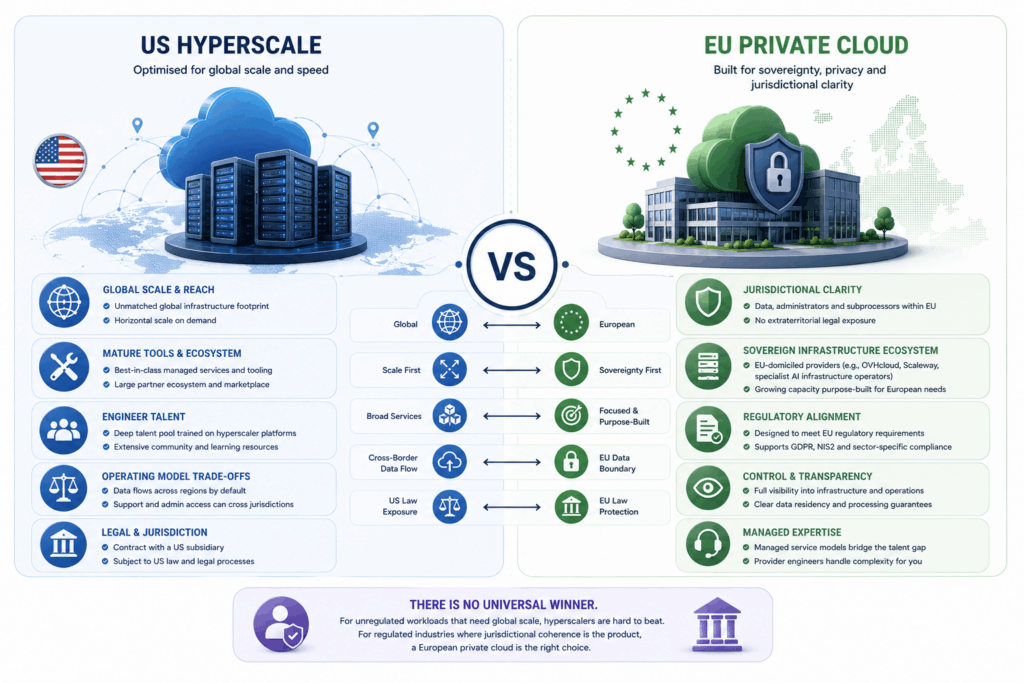
US hyperscalers are optimised for horizontal scale at global reach. That optimisation produces remarkable engineering, but it also produces a specific operating model.
Data flows across regions by default unless you work hard to constrain it. Support and administrative access can traverse jurisdictions.
The legal entity you contract with is a subsidiary of a US parent subject to US law. Hyperscalers also benefit from deep partner ecosystems and a large pool of engineers already trained on their platforms. For workloads where jurisdictional control is not a primary concern, this model is arguably hard to beat.
EU private cloud operates on a different premise. It does not try to match hyperscaler breadth, but instead competes on jurisdictional clarity and the absence of extraterritorial exposure.
A growing ecosystem of EU-domiciled infrastructure providers is building capacity specifically for this market. The EU’s GAIA-X initiative, while still maturing, reflects the institutional recognition that Europe needs its own sovereign data infrastructure layer.
A well-built European private AI cloud offers something the hyperscalers structurally cannot: a stack where every administrator, every subprocessor, and every physical asset sits within a coherent European regulatory perimeter.
The system and talent gap is real, but it is increasingly addressed through managed service models where the provider’s engineers handle the infrastructure complexity on behalf of the client. For a regulated bank or a national health service, jurisdictional coherence is the product.
The geopolitics of silicon
All of the above presumes that Europe has reliable access to the hardware required to run a sovereign AI stack.
High-end GPU accelerators like the NVIDIA H100 and Blackwell B200 are designed in the United States, fabricated almost exclusively in Taiwan and allocated through a market where US export controls and long-standing hyperscaler relationships shape who gets what and when.
European buyers are latecomers in this queue. An EU sovereign AI provider is not immune to what happens in Washington or Taipei. It is simply managing that exposure on behalf of its customers rather than passing it through unmanaged.
There are mitigations:
- Multi-vendor hardware strategies that reduce single-supplier dependency
- Early engagement with European and alternative accelerator programmes
- Software optimisation that extracts more from each GPU generation
- Long-term framework agreements with suppliers that secure capacity ahead of demand cycles
But none eliminate the underlying dependency. Anyone selling sovereign AI without a serious answer on silicon supply is selling an incomplete proposition.
Privacy law as a competitive advantage
There is a persistent narrative, mostly imported from outside Europe, that GDPR and the AI Act are drags on European competitiveness, that regulation strongly inhibits operational performance.
It is a convenient story for people who would prefer Europe not to regulate, but it has worn thin against the evidence. The jurisdictions with the strictest data sovereignty and AI privacy rules are also the ones where buyers are willing to pay a premium for trustworthy systems, whether those buyers are enterprises or public institutions.
An AI product built from the start to be explainable, auditable, data-minimising and jurisdictionally coherent is not simply compliant in Europe. It is substantially more trustworthy in any regulated market, which increasingly means any market at all. Japanese, Canadian, Brazilian, and South Korean rules are converging on a European shape.
European AI companies that recognise this are building products whose value proposition is the regulatory environment: privacy-preserving by construction and sovereign by default.
The public sector shift to private AI clouds
Nowhere is the data sovereignty question sharper than in the public sector. A government running citizen-facing AI services on foreign-owned infrastructure is, in a literal sense, outsourcing part of the state apparatus to a company it does not control, in a jurisdiction it does not govern.
For a long time, this was tolerated as a pragmatic trade-off. It is tolerated less and less.
European governments at every level are moving sensitive AI workloads onto private AI clouds operated by European entities. France’s “Cloud de Confiance” doctrine has formalised this at the national level, establishing certification requirements for cloud providers handling sensitive government data (source: the writer should verify and link to the ANSSI SecNumCloud certification framework).
Healthcare systems are adopting sovereign infrastructure for diagnostic AI and patient-data processing. Defence and intelligence services, unsurprisingly, never left. Tax authorities and courts are following.
These are exactly the workloads where the EU AI Act’s high-risk classification applies, where GDPR’s special-category data rules apply and where a failure of AI sovereignty is not a PR problem but a constitutional one.
Procurement patterns here are informative for the private sector. Public buyers have been earlier than most to insist on contractual data sovereignty: operational control inside the EU, subprocessors inside the EU and demonstrable immunity from non-EU legal demands.
Those contract terms are migrating into enterprise RFPs.
What a credible European sovereign AI stack looks like
The requirements described above add up to a specific kind of infrastructure that does not emerge by accident.
At the legal and operational level, the baseline is non-negotiable:
- The legal entity operating the service is EU-domiciled, with no parent relationship that exposes it to extraterritorial access demands
- Every subprocessor in the chain meets the same test
- Physical infrastructure is located in EU member states
- Staff, administrators, and support functions sit within the same jurisdiction
- Training and inference environments are isolated from non-EU networks by design, not by configuration
The harder part is the engineering layer, and this is where sovereign AI infrastructure demands the same technical disciplines as any serious AI-ready infrastructure build. GPU capacity has to be real, not theoretical.
Current sovereign deployments are built on NVIDIA H100 and A100 accelerators, with Blackwell B200 architecture on the horizon. These need dense, liquid-cooled clusters with high-speed InfiniBand or RDMA networking to support distributed training workloads.
NVMe-based storage with GPUDirect support ensures the compute layer is not starved of data.
Kubernetes and Kubeflow provide the orchestration layer for managing GPU scheduling, job fault tolerance, and multi-tenant isolation.
The software layer has to be open enough to avoid locking customers into a second foreign dependency dressed in European clothing. Model hosting has to support the open-weight ecosystem and the specific requirements around fine-tuning on sensitive data without that data leaving the sovereign perimeter.
SkyBiometry is built on this model. EU-domiciled through its parent company, Neurotechnology, with physical infrastructure in the Baltics and operational control entirely within the European Union. Every client works with a dedicated AI engineer who handles the infrastructure complexity, from cluster configuration and training pipeline optimisation through to production monitoring, so that the client’s team can focus on the AI workload rather than the underlying stack.
Where this leaves European organisations
The era of defaulting to hyperscaler AI deployment and documenting the residual risk is closing. For high-risk and regulated workloads, it has already closed. For general enterprise workloads, it is closing over the next 18-24 months, driven by the AI Act enforcement.
The organisations that have thought about this longest are already moving:
- Treat data sovereignty as a design requirement from the start
- Classify workloads by risk and data sensitivity
- Move the workloads that clearly belong in a sovereign environment first
- Use that experience to build the internal capability to assess the rest
The question for most European organisations is no longer whether to use it, but how quickly they can move the workloads that should have been there all along.
If your organisation is evaluating sovereign AI infrastructure, SkyBiometry engineers AI factory environments and operates private AI cloud services from EU-resident infrastructure, purpose-built for regulated workloads.
Feel free to get in touch if this important area concerns your project and you require the expert guidance it requires.