AI-ready infrastructure is a purpose-built stack where every component, from compute and storage to networking and cooling, is engineered to eliminate idle resources and sustain the demands of production-scale machine learning.
It represents a fundamental shift from general-purpose data centre architecture toward what the industry now calls the AI factory: an environment designed for continuous AI production rather than batch processing or experimentation.
A traditional data centre runs mixed workloads across commodity hardware. An AI factory is built around dense, liquid-cooled GPU clusters optimised for massive parallel processing and ultra-fast data throughput. Every layer of the stack is designed to keep the most expensive components in the rack working at full capacity, around the clock.
This guide breaks down the core layers of that stack, the engineering disciplines required to operate it, and the strategic decisions organisations face when deciding how to access it.
Understanding AI workloads
Before examining the infrastructure itself, it is worth distinguishing the primary workload types that an AI-ready stack must support. Each places different demands on the underlying hardware.
Training is the most compute-intensive phase. It involves processing vast datasets across large GPU clusters to build or update a model’s parameters. Training runs can last days or weeks, require sustained high-throughput interconnects between nodes, and consume the most power.
Inference is the production phase, in which a trained model processes new inputs and returns predictions. Inference workloads are latency-sensitive rather than compute-bound. They benefit from smaller, optimised deployments tuned for fast response times rather than raw throughput.
Fine-tuning sits between the two. Techniques like Parameter-Efficient Fine-Tuning (PEFT) allow organisations to adapt a pre-trained foundation model to domain-specific data without retraining from scratch. Fine-tuning requires meaningful GPU capacity but at a fraction of the scale needed for full training runs.
An AI-ready stack must accommodate all three. Infrastructure optimised solely for training will be inefficient at inference, and the reverse is equally true. The ability to allocate and reallocate resources across these workload types is what separates a well-designed AI factory from an expensive cluster that only serves one purpose.
The Core Stack
GPU as the primary asset
In an AI-ready environment, the traditional hardware hierarchy is inverted. The CPU handles the operating system, manages data movement, and schedules tasks, but it lacks the parallel processing architecture required for neural network training. The GPU is the engine.
AI workloads are fundamentally matrix multiplication at scale, and the thousands of specialised cores in modern accelerators make the GPU the most valuable component in the rack.
At the integrated system level, NVIDIA’s DGX platforms provide a reference architecture for enterprise AI infrastructure, packaging multiple accelerators with high-speed interconnects, networking, and storage into a single node.
For organisations building custom configurations at greater scale, HGX baseboards offer the multi-GPU platform layer, allowing engineers to design cluster topologies tailored to specific workload profiles. Current-generation deployments are built around the H100 and A100 architectures, with Blackwell B200 introducing the next step in compute density.
Silicon has become a strategic asset. The Total Cost of Ownership (TCO) equation now extends well beyond the purchase price. The electricity required to run a high-end accelerator over a three-year lifecycle often rivals the cost of the hardware itself. For organisations evaluating generative AI infrastructure requirements, understanding this TCO dynamic is the starting point for any serious infrastructure decision.
Thermal management
Temperature is no longer a maintenance concern. It is a direct constraint on performance and on the operational economics of the AI factory. When a GPU hits its thermal limit, typically between 80 and 85°C, it triggers thermal throttling, automatically reducing clock speed to prevent physical damage. In a cluster running hundreds of accelerators at 700W or more each, air cooling simply cannot keep pace.
AI-ready infrastructure now relies on Direct-to-Chip (DLC) liquid cooling or full immersion cooling, where servers are submerged in non-conductive fluid. These approaches enable the extreme rack densities that modern AI workloads demand while maintaining reliability across sustained training cycles.
Power consumption, cooling strategy, and operational cost are not isolated decisions. They form an interconnected design challenge that shapes the economics of the entire facility.
High-performance storage
Storage in an AI context is measured by throughput and IOPS (Input/Output Operations Per Second), not raw capacity. Slow storage creates GPU starvation: accelerators sit idle because they cannot be fed data fast enough.
Modern AI stacks address this at two layers. At the file system level, parallel distributed file systems like BeeGFS stripe data across multiple storage nodes, delivering the aggregate throughput needed to feed large GPU clusters simultaneously.
At the transport level, NVMe-over-Fabrics (NVMe-oF) combined with NVIDIA GPUDirect Storage allows GPUs to pull data directly from SSDs across the network fabric, bypassing the CPU entirely. Remote drives deliver throughput as if they were plugged directly into the GPU’s own circuit board.
For organisations designing generative AI infrastructure, getting the storage layer right is as critical as choosing the right GPU.
Networking fabric
In distributed training, the network is the backplane of the cluster. The bottleneck is rarely the processing power of any single chip. It is the speed at which chips communicate during synchronisation operations like all-reduce.
High-bandwidth, low-latency fabrics such as InfiniBand or RDMA over Converged Ethernet (RoCE) are non-negotiable for serious training workloads.
Without them, synchronisation latency stalls GPU resources and degrades cluster efficiency. The choice between InfiniBand and Ethernet-based solutions depends on cluster scale, workload type and budget, plus warrants detailed evaluation on its own terms.
Orchestration: Why standard Kubernetes is not enough
Kubernetes has become the orchestration layer of the AI data centre as cluster complexity grows. But standard Kubernetes was not designed for GPU workloads. It requires significant specialisation to function effectively in this environment.
GPU scheduling and multi-instance partitioning – Technologies like NVIDIA Multi-Instance GPU (MIG) allow a single H100 to be partitioned into up to seven isolated instances, enabling Kubernetes to serve multiple inference tasks simultaneously on one piece of hardware. This maximises utilisation and prevents the financial cost of idle GPUs.
Fault tolerance and checkpointing – Training runs on large clusters can last weeks. A single node failure in a thousand-GPU cluster could halt an entire training job. Kubernetes, paired with frameworks like Kubeflow, manages automated checkpointing: saving model state at regular intervals and restarting failed tasks on healthy nodes without human intervention.
Topology awareness – The scheduler must understand the physical layout of the cluster. Which GPUs share the same high-speed interconnect, which sit on the same rack and communicate across a spine switch? Topology-aware scheduling minimises data transfer latency between co-dependent processes, directly impacting training throughput.
Operational monitoring and capacity planning – Running a production AI cluster requires continuous visibility into GPU utilisation rates, job queue depth, thermal thresholds, and power draw. Automated alerting on utilisation anomalies, capacity forecasting based on workload trends, and job scheduling optimisation are what separate a well-run AI factory from expensive underperformance. Without this layer, engineering teams lose sight of where resources are going and where bottlenecks are forming.
These are core AI infrastructure and operations fundamentals. The orchestration and operational decisions that determine whether a cluster performs like a single coherent machine or a collection of expensive hardware pulling in different directions.
The role of the AI Infrastructure engineer
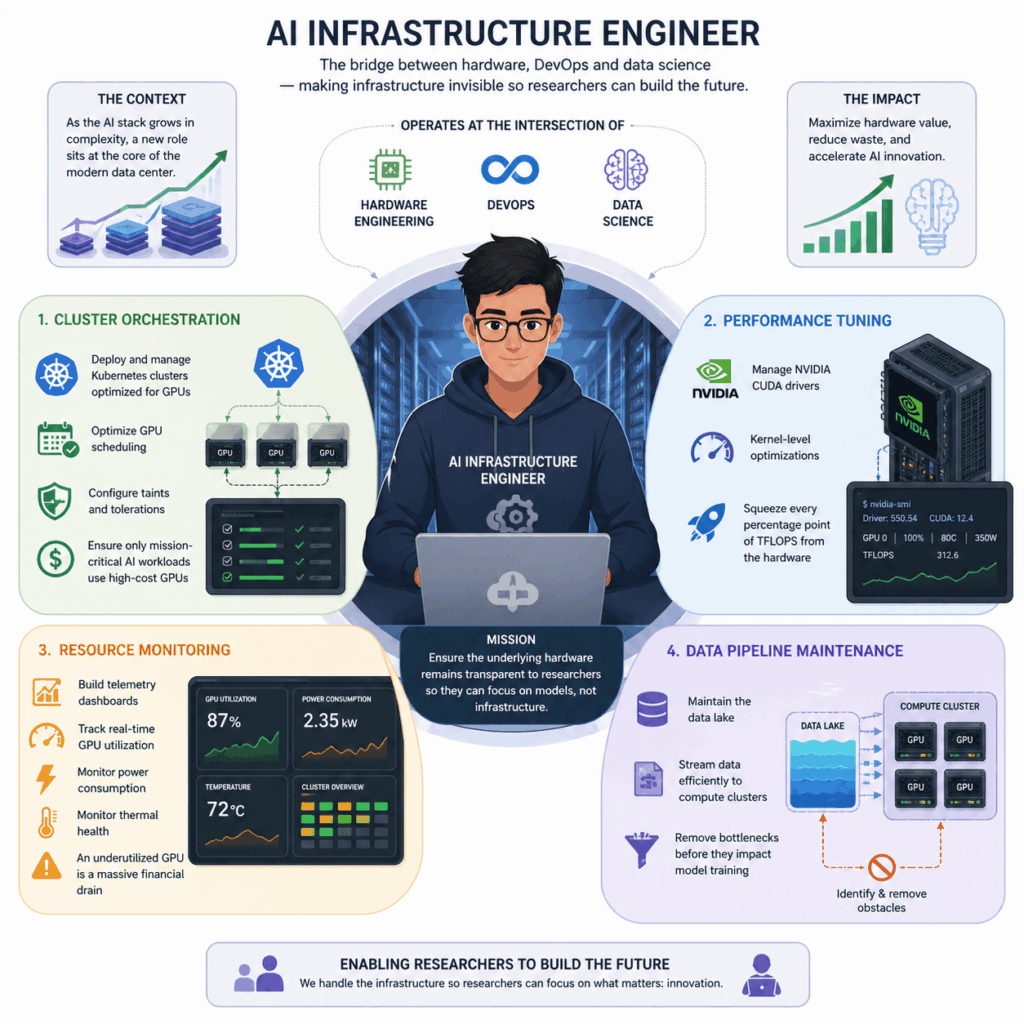
The complexity of this stack has produced a distinct engineering discipline. An AI infrastructure engineer works at the intersection of hardware engineering and DevOps. Their job is to make the underlying infrastructure invisible to the researchers and data scientists building models on top of it.
What does that look like day to day?
– Deploying and managing GPU-optimised Kubernetes environments with correctly configured scheduling and tolerations so that mission-critical workloads land on the right hardware.
– Managing NVIDIA CUDA drivers and kernel-level optimisations to extract maximum TFLOPS from the available silicon. – Building the telemetry and monitoring systems described above, tracking real-time GPU utilisation, power consumption and thermal health.
– Maintaining the data pipeline so that the storage layer streams data to the compute cluster without bottlenecks that stall training.
All of these roles play an important part because an underutilised GPU is a direct financial loss.
This role barely existed five years ago. It has become one of the most critical positions in any organisation running production AI workloads.
Build, buy or partner: evaluating solutions for AI Infrastructure
The most consequential AI infrastructure solutions decision most organisations face is how to access compute at the scale they need.
Building on-premise offers maximum control, data sovereignty, and long-term cost efficiency at scale. The trade-off is significant capital expenditure, specialist engineering talent, and ongoing operational commitment. A private AI factory capable of serious training workloads represents a substantial investment before a single model is trained.
Buying cloud capacity provides immediate access and flexibility. Organisations can rent GPU clusters for short bursts of intensive training and scale down for inference. Cloud providers also offer pre-configured AI stacks (CUDA, PyTorch, TensorFlow), reducing deployment time considerably. The cost at sustained scale and reduced control over the physical environment are the downsides.
Partnering with a managed provider combines elements of both. Managed bare-metal hosting delivers the dedicated performance and data sovereignty of an on-premise build with the operational support of a cloud model. The provider handles cooling, hardware lifecycle, and driver management. The organisation retains dedicated compute throughput and full control of its software environment. The broader industry shift from application-layer cloud services toward infrastructure-level platform models reflects how seriously organisations are taking this middle path.
Most organisations find this is not a binary decision. Hybrid approaches that combine a core private AI factory with burst cloud capacity or managed infrastructure for specific workloads have become the norm.
NVIDIA has formalised a layered approach to AI factory architecture that provides a useful framework for evaluating where each component of the stack should sit.
Cost management and sustainable operations
At scale, AI infrastructure is as much a financial and environmental challenge as a technical one. A high-performance GPU cluster can consume as much power as a small industrial facility. Without disciplined operational practices, costs compound quickly.
Spot and preemptible instances allow organisations to access GPU capacity at significant discounts by using spare cloud capacity. These instances can be reclaimed at short notice, but they work well for non-critical tasks like data preprocessing, batch inference, or hyperparameter sweeps.
Dynamic power management is becoming standard practice. Shifting heavy workloads to off-peak grid hours, routing compute to data centres powered by renewable energy, and using liquid cooling to reduce facility-wide energy consumption all contribute to lowering the Power Usage Effectiveness (PUE) ratio.
Resource observability is the defence against cloud sprawl. Without real-time telemetry tracking GPU utilisation, storage allocation, and cost attribution by team or project, forgotten experimental clusters and orphaned storage volumes drain budgets undetected. Production AI operations require clear visibility across the entire stack.
Security, multi-tenancy and data sovereignty
For organisations handling sensitive data, the AI model and its training dataset are the most valuable intellectual property in the business. If this data is compromised, the competitive advantage is gone.
Air-gapped environments, physically isolated systems with no connection to the public internet, remain the standard for high-stakes deployments. They add complexity to software updates and model deployment workflows, but for regulated industries and government use cases, they are a non-negotiable requirement. Keeping the entire pipeline from data lake to GPU cluster within a private, controlled perimeter eliminates the risk of external exfiltration.
Multi-tenant isolation matters for any organisation running shared clusters. When multiple teams or clients share the same physical infrastructure, every layer needs to enforce separation. Network segmentation prevents cross-tenant traffic while storage partitioning keeps datasets and model weights contained. Compute-level resource quotas guarantee that one team’s training run does not starve another’s inference workload, and Role-Based Access Control (RBAC) governs who can access what. Get any of these wrong and shared infrastructure stops being an efficiency gain and starts being a liability.
Encrypted data-in-transit across the networking fabric is equally important. Distributed training moves massive datasets across hundreds of nodes, and the high-speed interconnects that make training possible are also potential points of exposure. Hardware-level encryption, such as MACsec, ensures data remains protected even at the physical layer.
Confidential computing uses Trusted Execution Environments (TEEs) to protect data while it is being processed in GPU memory, not just at rest or in transit. As regulatory frameworks evolve, particularly in Europe, these protections are expected to become essential components of AI-ready infrastructure.
What comes next?
AI-ready infrastructure is an integrated engineering discipline spanning compute, storage, networking, cooling, orchestration, and security. The AI factory model, where every layer is designed to keep the most valuable hardware running at full capacity, is replacing the general-purpose data centre as the foundation for serious AI work.
Organisations that treat infrastructure as a strategic investment rather than a commodity purchase are the ones building durable competitive advantage.
If your organisation is evaluating how to build or operate AI-ready infrastructure, SkyBiometry engineers AI factory environments from the ground up. The knowledgeable team here at SkyBiometry provide AI infrastructure solutions, including GPU clusters, storage, networking and orchestration built for production workloads.