
Shipping a model should not be overlooked when it comes to important phases of AI model development. A system that hit its accuracy targets last quarter can quietly degrade, causing numerous financial and operational issues to businesses.
Organisations getting durable value from AI have figured out that models are living assets that need ongoing oversight and maintenance.
AI model lifecycle management is the discipline built around that reality: planning, building, deploying, monitoring, governing and retiring machine learning models in a structured, auditable way.
This guide covers every stage of that lifecycle, along with the governance and regulatory considerations that underpin the whole system.
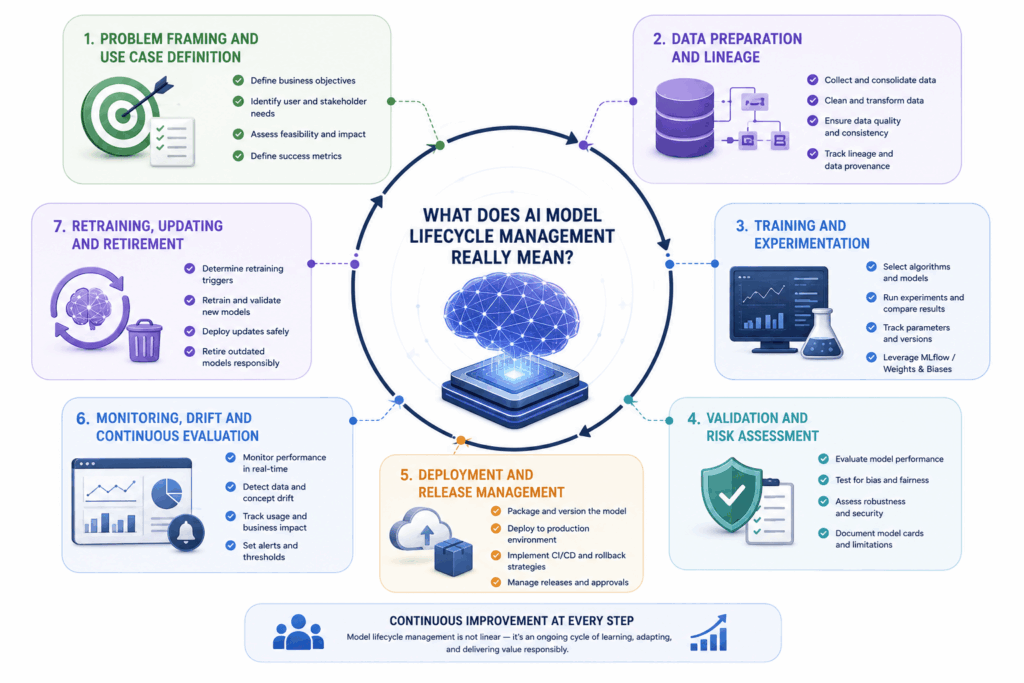
What does AI Model lifecycle management really mean
In practical terms, AI model lifecycle management is what keeps a model fit for purpose from the day it enters development to the day it gets switched off.
It borrows heavily from DevOps but layers on concerns that traditional software engineering never had to deal with: data provenance, statistical drift, fairness metrics, explainability and the unsettling reality that a model’s behaviour can change even when its code has not.
The closest analogy is asset management for probabilistic systems. A trained model is a snapshot of patterns learned from a specific dataset at a specific moment. The world keeps moving, but the model does not.
Lifecycle management keeps the two in reasonable alignment and makes sure that when something goes wrong, a human can reconstruct exactly what happened and why.
The discipline covers seven phases, each with its own tooling, stakeholders and failure modes.
Phase One: problem framing and use case definition
Every successful model starts with a clearly defined problem. Less glamorous than training neural networks, but this is where most AI projects quietly fail.
Before any data is collected, the team needs to answer hard questions:
- What decision will this model actually inform?
- Who is accountable for its outputs?
- What is the cost of a false positive versus a false negative?
- What would “good enough” look like in measurable terms?
Skip this step and you end up with models that impress in a demo but serve no operational purpose. A fraud detector with 99% accuracy sounds brilliant until the team realises the 1% of missed fraud represents the only cases worth catching.
Clear problem framing also lays the foundation for the risk classification that governance and regulatory steps later depend on.
Phase Two: data preparation and lineage
Data is where most of the lifecycle’s long-term liability lives. A model is only as trustworthy as the data it learned from, and that trustworthiness has to be provable months or years later when someone asks why a particular prediction was made.
Modern lifecycle practice treats data with the same rigour as code. Datasets are versioned using tools like DVC (Data Version Control), with sources documented and any personally identifiable or sensitive fields flagged and governed separately.
Data lineage tracking records record which training run, and that matters for three reasons:
- Debugging model failures – When a production model makes a bad prediction, lineage lets the team trace back to the exact training data that shaped that behaviour.
- Regulatory response – Requests for explanation under frameworks like the EU AI Act require provable documentation of what data a model learned from.
- Retraining decisions – Understanding what data the current model was trained on is a prerequisite for deciding what new data should go into the next version. Without lineage, retraining becomes guesswork.
Phase Three: training and experimentation
Training accounts for a surprisingly small share of the total lifecycle effort. The key concern at this phase is reproducibility.
Every training run should capture the exact dataset version, hyperparameters, code commit and compute environment used, so that any resulting model can be rebuilt from scratch if needed.
Experiment tracking platforms like MLflow and Weights & Biases have become standard for any serious ML team. Without them, organisations end up with production models whose origin stories are essentially folklore.
No model making consequential decisions should be that poorly documented.
Phase Four: validation and risk assessment
Performing well on a test set does not mean a model is ready for production. Validation in a mature lifecycle programme goes well beyond accuracy metrics to include bias and fairness testing, robustness testing against adversarial or out-of-distribution inputs, explainability checks and security review for risks like prompt injection or data leakage.
Risk classification happens formally at this stage. Is this model informing a low-stakes internal recommendation, or is it making access control decisions in a biometric verification system where a false rejection locks a legitimate user out?
The answer determines scrutiny levels before deployment and what human oversight looks like during operation.
Phase Five: deployment and release management
Deploying a model into production is where ML engineering meets traditional software engineering. Containerisation, version control, rollback mechanisms, canary releases and A/B testing all apply.
Where model deployment diverges from conventional software delivery is in the coordination required with data pipelines, feature stores like Feast and monitoring infrastructure that are absent in traditional applications.
Good release management treats every production model as a distinct artifact with:
- A unique version identifier
- A documented owner
- A registered entry in a central model registry (MLflow’s model registry has become the standard open-source solution, providing versioning, staging, and promotion workflows)
- A serving layer handling the transition from registered model to live predictions (frameworks like KServe or Seldon Core manage model serving, traffic splitting, and autoscaling in Kubernetes environments)
When something breaks at 2 a.m., the on-call engineer needs to know immediately which model version is running and how to roll back safely.
Phase Six: monitoring, drift and continuous evaluation
This is where most AI programmes underinvest. It is also where most production incidents originate.
Understanding model drift
Model drift is the gradual or sudden degradation of a model’s predictive performance in production. It typically takes one of two forms:
- Data drift occurs when the statistical properties of the input data change. Customer behaviour shifts, new product categories appear, or a sudden market disruption rewrites patterns overnight.
- Concept drift occurs when the relationship between inputs and the correct output changes, even if the inputs themselves look similar.
Catching drift early requires continuous monitoring of input distributions and prediction distributions. Tools like Evidently AI provide drift detection and reporting out of the box, while Prometheus and Grafana handle infrastructure-level metrics: latency, throughput, and cost per inference.
Threshold-based alerts flag when key metrics deviate meaningfully from training-time baselines, giving teams a window to intervene before business impact becomes severe.
Beyond accuracy
Modern monitoring does not stop at predictive performance. A comprehensive monitoring programme also tracks:
- Latency and throughput under production load
- Cost per inference across different model versions
- Fairness metrics across protected groups
- For generative systems: rates of hallucination, toxicity, and policy violations
The observability stack for AI is broader than for traditional software and is still evolving rapidly.
Phase Seven: retraining, updating and retirement
Every model eventually needs to be retrained or replaced. The question is when and how. Choosing the right retraining strategy is as much a business decision as a technical one.
Scheduled retraining refreshes the model at fixed intervals, whether weekly, monthly or quarterly, regardless of whether drift has been detected. Predictable and well-suited to domains where data distributions shift gradually.
Triggered retraining kicks off only when monitoring systems detect meaningful drift or performance degradation. More compute-efficient, but requires a mature monitoring infrastructure and clear thresholds. Teams should be cautious of triggering retraining on noise rather than signal, which can introduce instability.
Continuous or online learning updates the model incrementally as new data arrives. Tightest feedback loop, but also highest operational risk, since a single batch of poisoned or anomalous data can degrade the model in ways that are hard to reverse.
Retirement is the phase almost nobody plans for. Models accumulate in production environments, quietly consuming compute and occasionally making decisions that nobody remembers authorising. A mature lifecycle programme defines clear criteria for sunsetting:
- A replacement model is live and stable
- The underlying use case has changed
- Regulatory requirements can no longer be met
- The cost of maintenance exceeds the value delivered
Retired models should be archived with their documentation intact, in case future audits or investigations require reconstruction.
Governance: the layer that holds everything together
Lifecycle management without governance is just a set of disconnected engineering practices. Governance binds the phases into a coherent, auditable system.
It answers questions like: who approves a production model, what evidence is required before a high-risk model goes live, how incidents are escalated and documented, and who is accountable when something goes wrong.
For small teams, governance can live in wikis and shared documents. For enterprises running dozens or hundreds of models across business units, that approach collapses under its own weight.
A dedicated category of enterprise AI governance tooling has emerged, with platforms spanning different approaches:
- Enterprise suite platforms like IBM OpenPages provide broad risk and compliance management with AI model governance as part of a wider GRC (governance, risk, compliance) framework.
- Cloud-native solutions like Google Cloud’s Model Registry and Vertex AI Model Monitoring integrate governance directly into the ML platform layer.
- Specialist AI monitoring platforms like Arthur AI focus specifically on model performance, bias detection, and explainability reporting.
Choosing between them depends on the scale of the model portfolio, integration requirements with the existing MLOps stack, regulatory reporting obligations and whether governance needs to span multiple teams or business units. For a detailed look at how these tools compare in practice, see our guide to governance tools for enterprise AI model lifecycle management.
Where governance tooling really earns its investment is defensibility. When a regulator or board member asks why a particular model made a particular decision on a particular date, the answer needs to be immediate and backed by evidence. Systems built on mature governance tooling can produce that answer in minutes.
Regulatory Considerations: The EU AI act and beyond
Regulation has moved from background noise to an active design constraint.
The European Union’s AI Act, which entered into force in August 2024 with phased enforcement extending through 2027, is the most comprehensive AI regulation adopted to date. It classifies AI systems by risk level, imposes specific lifecycle obligations on providers and deployers of high-risk systems and carries fines that can reach the higher of 35 million euros or 7% of global annual turnover for the most serious violations.
Providers of high-risk AI systems operating in the European market are required to:
- Maintain technical documentation covering training data, design choices, validation results, and monitoring procedures
- Implement post-market monitoring systems
- Report serious incidents to the relevant authorities
- Ensure human oversight is meaningful rather than ceremonial
Much of this maps directly onto the lifecycle phases described above. The Act codifies what good lifecycle practice already looks like.
For organisations operating in Europe, these requirements also intersect with broader questions about data sovereignty and where AI workloads are physically located.
The need to maintain auditable documentation and demonstrate compliance with data residency rules is driving increased demand for sovereign AI infrastructure that keeps model data and compute within jurisdictional boundaries.
Other jurisdictions are following with their own frameworks. The United States has taken a sector-specific approach through agencies like the FDA, EEOC, and CFPB, while the United Kingdom, Canada, and others are at various stages of rulemaking.
For any organisation operating internationally, lifecycle documentation is the minimum evidence base for demonstrating compliance across jurisdictions.
Building lifecycle processes around auditability from the beginning pays off in speed and reduced rework.
Building a lifecycle program: where should you start?
The temptation for organisations just beginning to formalise lifecycle management is to buy a platform and hope it solves everything. Platforms work best when they sit on top of clear organisational roles and documented policies for the models in production.
A reasonable starting sequence:
- Take stock of every model currently running in production, including the ones nobody wants to admit exist.
- Classify each one by risk and business impact.
- Define minimum documentation and monitoring standards for each risk tier.
- Invest in tooling that matches the scale of the portfolio, using the model registries, experiment trackers and monitoring tools described above.
- Assign clear ownership for every model and every lifecycle phase.
Only then does a dedicated governance platform start paying for itself. The sequence takes time, but the organisations that have been through it are the ones now shipping AI at scale without regulatory panic and without production incidents making the news.
In Summary
AI model lifecycle management is an operating discipline, not a product or a one-time project. The phases described here, from problem framing through retirement, are the scaffolding. The real work goes into preventing model drift and aligning with ever-changing regulations.
The difference between organisations that will still be running AI effectively in five years and those explaining to their boards why their models stopped working comes down to whether they treated lifecycle management as core infrastructure or as a compliance cost.
If your organisation is ready to move from ad hoc ML operations to a governed, auditable lifecycle programme, SkyBiometry provides production hosting and full lifecycle management for AI systems built on dedicated GPU infrastructure.
Learn more about how our approach to applied AI solutions and custom models can benefit your enterprise.