
Most organisations building AI today do not own their own GPU clusters. Instead, they rent them. GPU cloud computing gives teams access to high-density accelerator infrastructure for AI training and inference without the capital expenditure or lead times that come with owning hardware.
The distinction from general-purpose cloud matters. These are not repurposed server farms with GPUs attached as an afterthought. Purpose-built GPU cloud infrastructure is engineered around accelerator density, high-speed networking fabrics and storage systems capable of sustaining continuous data flow to keep GPUs working at full capacity.
This guide covers how GPU cloud computing works at the infrastructure level: selecting the right accelerator hardware, designing cluster networking, understanding cost dynamics, evaluating providers and accessing high-performance compute in the European market.
GPU architectures for cloud compute
Hardware selection is the first major decision in any GPU cloud computing deployment as it shapes everything downstream. The accelerator you choose determines important metrics such as training throughput, inference latency, power draw and influencing the final cost per job.
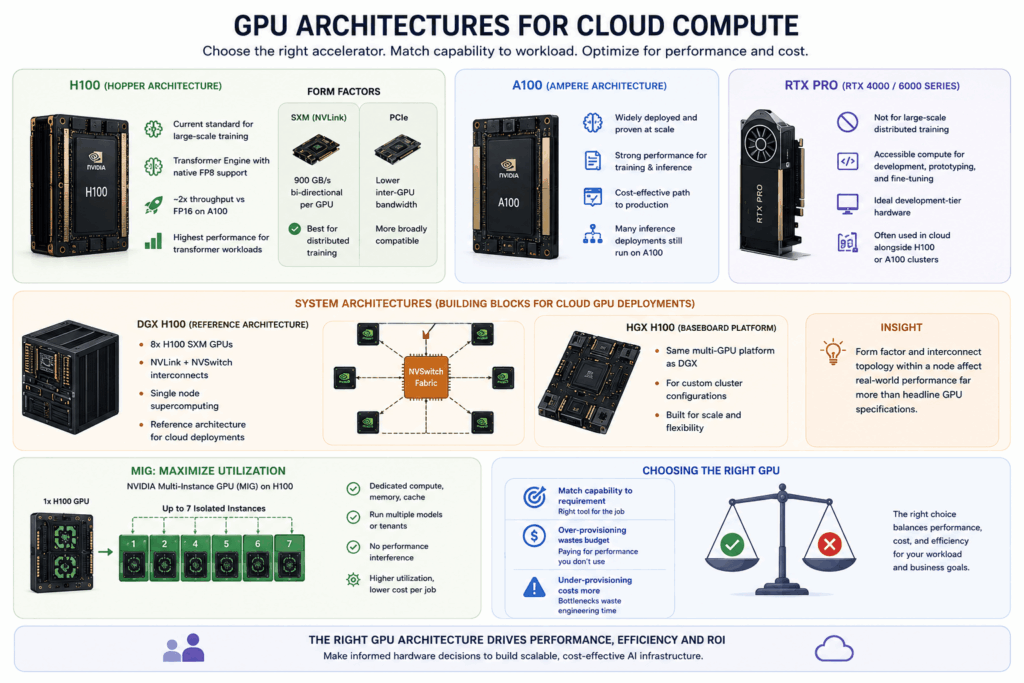
The NVIDIA H100 is the current standard for large-scale training. It runs on the Hopper architecture and introduces the Transformer Engine with native FP8 precision support, roughly doubling throughput on transformer-based models compared to FP16 on the previous generation. H100s come in two form factors that perform very differently in multi-GPU setups. SXM variants connect via NVLink with 900 GB/s of bidirectional bandwidth per GPU, making them the relevant choice for distributed training. PCIe variants are more broadly compatible but offer substantially lower inter-GPU bandwidth.
At the system level, NVIDIA’s DGX H100 packages eight SXM accelerators with NVLink and NVSwitch interconnects into a single node. This is the reference architecture for cloud GPU deployments. HGX baseboards offer the same multi-GPU platform for providers building custom cluster configurations. The form factor and interconnect topology within a node affect real-world performance far more than headline GPU specifications suggest.
The A100 remains widely deployed and continues to deliver strong performance across training and inference. For organisations where H100 availability is constrained or where workloads do not fully exploit Hopper’s architectural improvements, A100 clusters offer a proven, cost-effective path to production. Many inference deployments still run on A100 infrastructure.
RTX Pro GPUs (RTX 4000 and 6000 series) fill a different role. They lack the memory bandwidth and interconnect performance for large-scale distributed training. Although, they provide accessible compute for development, prototyping and smaller fine-tuning jobs. In managed GPU cloud services, they often serve as development-tier hardware alongside production-tier H100 or A100 clusters.
NVIDIA Multi-Instance GPU (MIG) adds another dimension to GPU cloud economics. MIG allows a single H100 to be partitioned into up to seven isolated instances, each with dedicated compute, memory and cache. For inference, a single physical GPU can serve multiple models or tenants simultaneously without performance interference. This turns expensive accelerators into efficiently shared resources and significantly improves utilization in mixed-workload environments.
Choosing the right GPU for a given workload means matching capability to requirement. Over-provisioning wastes budget on performance that never gets used. Under-provisioning is worse: the bottlenecks it creates typically cost more in wasted engineering time than the hardware savings are worth.
Networking for GPU cloud clusters
Networking performance in GPU cloud computing determines whether expensive accelerators run efficiently or sit idle waiting for data. Distributed training requires GPUs to exchange gradient updates continuously during synchronisation operations like all-reduce. When the network cannot keep pace, GPUs stall between computation steps and effective utilization drops.
GPU cluster networking operates at two distinct levels:
Intra-node communication happens between GPUs within a single server. NVIDIA’s NVLink provides the high-bandwidth, low-latency fabric for this, delivering up to 900 GB/s of bidirectional bandwidth per GPU on H100 systems. NVSwitch extends this further, enabling all-to-all GPU communication within a node without bottlenecks. For workloads that fit within a single multi-GPU node, NVLink performance is often the deciding factor in overall throughput.
Inter-node communication connects separate servers across the cluster. InfiniBand, particularly NVIDIA’s ConnectX and Quantum switch families, delivers the lowest latency and highest bandwidth for large-scale distributed training. Clusters running hundreds of GPUs across multiple nodes need non-blocking InfiniBand fabrics with RDMA to achieve the synchronisation performance that keeps training efficient.
Ethernet-based alternatives using RoCEv2 have improved significantly and can be competitive for smaller clusters or inference-heavy workloads where absolute lowest latency is less critical.
The cost difference between InfiniBand and high-performance Ethernet can be substantial, and for many cloud GPU deployments, the practical answer is InfiniBand for training clusters and Ethernet for inference serving.
Topology matters too. Spine-leaf architectures are standard, but the oversubscription ratio at each level directly affects performance under load.
A cluster that benchmarks well under light traffic will degrade when hundreds of GPUs are synchronising simultaneously during a large training run. Networking that looks adequate on paper can become the binding constraint in production.
The economics of GPU cloud computing
Cost is where GPU cloud computing decisions ultimately play out. The economics run deeper than a per-GPU hourly rate and headline pricing alone does not tell you what you will actually spend.
- Total cost of ownership has several layers – Hardware acquisition or rental is the most visible. Power consumption, cooling, networking equipment, storage and the engineering staff to operate everything can match or exceed hardware cost over a three-year cycle. For organisations debating cloud GPU rental against dedicated infrastructure, the break-even calculation hinges on sustained utilization. At low or variable utilization, cloud rental is more economical. At consistently high utilization, above roughly 60-70%, dedicated or managed infrastructure pulls clear significantly.
- Utilization is the hidden multiplier – A GPU sitting idle between training jobs still draws power and depreciates. Well-run GPU cloud infrastructure maximises utilization through intelligent orchestration and workload scheduling that keeps accelerators busy. MIG partitioning plays a part too, allowing inference workloads to fill GPU capacity that would otherwise sit unused between training runs.
- Tokens per watt captures how effectively a system converts energy into useful output, factoring in both hardware capability and software optimisation. For sustained production workloads where energy costs compound week after week, this metric drives real procurement decisions. Raw FLOPS numbers tell you what the hardware can theoretically do. Tokens per watt tells you what it actually delivers.
- Hyperscaler pricing includes infrastructure costs, operational margin and the premium for on-demand flexibility. For short-burst workloads or experimentation, that premium buys speed and eliminates procurement timelines. For sustained production workloads, the cumulative margin adds up. Private and managed GPU cloud services reduce this by removing the intermediary markup, though they require either internal operational expertise or a managed service partner.
- Batching and throughput optimisation directly affect inference economics at scale. Dynamic batching groups multiple inference requests together, dramatically improving GPU utilization and reducing per-request cost. Larger batches are more efficient but introduce processing delay. NVIDIA Triton Inference Server has become the standard tool for managing this balance, providing configurable batching policies alongside model orchestration and multi-framework support.
For a detailed treatment of how these cost dynamics interact, see our analysis of Tokenomics and the Compute Economy.
Evaluating GPU cloud providers
The range of GPU cloud providers has grown rapidly and the quality of offerings varies more than you may think. Beyond the per-GPU price, several factors separate providers that deliver real production value from those that do not.
- Hardware specifications need verification – Not all H100 deployments are equivalent. SXM configurations with NVLink interconnects deliver fundamentally different performance from PCIe configurations in multi-GPU workloads. Providers should be transparent about form factors, interconnect topology and whether GPU memory is HBM3 or HBM2e. Single-GPU benchmark claims do not reflect real distributed training throughput.
- Networking infrastructure determines how well performance scales – A provider offering H100s connected via Ethernet may deliver strong single-node results but degrade when workloads spread across multiple nodes. Ask about matters like interconnect technology and how performance holds up as cluster size increases.
- SLA structures vary widely – Uptime guarantees are standard, but performance SLAs are not. Does the provider guarantee consistent GPU throughput, or only that the hardware is technically accessible? For production AI workloads, that distinction changes the risk profile of the entire deployment.
- Operational support depth separates providers – Some hand over API credentials and leave the rest to the client. Others assign dedicated engineers who work alongside the client’s team, helping to optimise training pipelines and manage hardware transitions. SkyBiometry’s managed GPU cloud services operate on this model, with a dedicated AI engineer assigned to every client.
- Burst capacity and contract flexibility determine fit for variable workloads. Can you scale GPU allocation up for an intensive training run and back down for inference? Are you locked into long-term commitments, or can you adjust capacity as requirements evolve?
Private GPU cloud versus public hyperscaler
To begin with, framing this as an either/or choice misses the point. The right answer depends on multiple factors such as workload characteristics, data sensitivity, cost horizon and how much operational responsibility the organisation is prepared to carry.
Public hyperscalers offer unmatched breadth of tooling, global availability and the ability to spin up GPU capacity in minutes. For experimentation, short-term training bursts and workloads where data sensitivity is not a primary concern, they remain the fastest path to compute.
Private GPU cloud offers performance consistency that shared environments cannot match. Dedicated hardware means no contention for GPU memory bandwidth and predictable job completion times. For organisations running sustained cloud GPU training or high-volume inference, this consistency translates directly into cost savings and planning reliability.
Data sovereignty and regulatory compliance increasingly tilt the decision toward private infrastructure for European organisations. Keeping models, training data and inference pipelines within controlled EU-resident infrastructure eliminates the jurisdictional exposure that comes with US-parented hyperscaler subsidiaries. For regulated industries, this is often non-negotiable.
The operational trade-off is worth noting. Private infrastructure requires either significant internal expertise or a managed service partner who handles hardware lifecycle management, driver updates, cluster orchestration and monitoring while providing dedicated compute that the client controls.
In practice, most organisations operating at scale adopt hybrid approaches. Core production workloads run on private or managed GPU cloud infrastructure for cost control and consistency, while burst capacity for intensive training comes from public cloud when needed.
Development and prototyping typically use lower-cost GPU tiers. Getting the balance right is a strategic decision, not a technical one.
Optimisation across hardware generations
Upgrading to a new GPU generation does not automatically deliver proportional performance gains. Architectural changes between generations affect how workloads should be structured and teams that swap hardware without adjusting their software stack consistently underperform.
The A100-to-H100 transition illustrates this clearly. H100’s Transformer Engine introduces native FP8 precision, which can roughly double throughput on transformer-based workloads compared to FP16 on A100. But that gain only materialises if the training framework and model code are configured for mixed-precision training with FP8. Without that software alignment, the H100 runs FP16 workloads faster than an A100 but nowhere near its theoretical peak.
Memory architecture matters too. H100’s HBM3 delivers approximately 3.35 TB/s of memory bandwidth compared to A100’s HBM2e at 2 TB/s. For memory-bound workloads, that gap is significant. For compute-bound workloads, the benefit is less pronounced. Understanding where a specific workload sits on the compute-memory spectrum determines how much real improvement a hardware upgrade delivers.
Orchestration and scheduling need to evolve alongside hardware. Newer GPU generations support different MIG partitioning profiles, different CUDA compute capabilities, and updated driver requirements. GPU cloud services that handle these transitions transparently, migrating workloads to new hardware without requiring the client to redesign their training pipeline, deliver genuine operational value.
Software stack alignment is where the real optimisation curves across hardware generations play out. CUDA toolkit versions, cuDNN optimisation, TensorRT for inference, and framework-level support in PyTorch and DeepSpeed all need to match the hardware they are running on. Hardware sets the ceiling. How close you actually get to it depends entirely on the software.
Access to GPU cloud for the European mid-market
Access to high-performance GPU cloud computing is not evenly distributed. Hyperscalers prioritise enterprise clients with substantial committed spend and mid-market organisations often struggle to access the latest hardware at competitive prices. Lead times for dedicated GPU clusters can stretch to quarters rather than weeks.
European mid-market companies face a compounding challenge. They need H100-class compute to compete on AI capability but lack the purchasing power to secure priority allocation. The constraint goes beyond just price; it also comes down to the requirement for necessary hardware which can scale with your workload, rather than being confined to a hyperscaler’s minimum commitment threshold.
Thankfully, regional GPU cloud providers and managed infrastructure operators are filling this gap. They maintain standing allocation agreements with GPU suppliers and offer dedicated access to H100 and A100 clusters without requiring hyperscale commitments. For European organisations, providers operating from EU-resident data centres add data sovereignty to the value proposition, keeping compute within European jurisdictional boundaries.
SkyBiometry’s GPU cloud platform is built for this market. Dedicated GPU clusters with managed operational support, predictable pricing without hyperscaler markup and an engineering partnership model that gives mid-market teams access to the same infrastructure quality that previously required enterprise-scale budgets.
What comes next?
GPU cloud computing sits underneath every serious AI deployment. The decisions covered here will compound over time and worsen. Getting them right early builds an advantage. Getting them wrong becomes expensive to unwind.
If your organisation needs high-performance GPU cloud computing with dedicated infrastructure, managed operational support and predictable pricing, discover SkyBiometry’s AI cloud and managed GPU services.