
AI agents are not an incremental upgrade to chatbots. They represent a structural shift in how software systems operate inside organisations. Where a chatbot processes a prompt and returns a response, an agent interprets context and plans actions, then interacts with tools and executes tasks across multiple systems without constant human direction. It maintains state and evaluates outcomes, adapting its approach based on results.
Supporting that kind of system requires a fundamentally different infrastructure stack. AI agent infrastructure goes beyond model hosting or API orchestration.
It is the integrated environment that allows agents to operate reliably within business workflows: access to data and systems, properly isolated execution environments, and governance controls to keep everything observable and secure.
This in-depth guide covers the core layers of that infrastructure, the architectural decisions organisations are making and what actually determines whether agents deliver value or stay stuck in pilot mode.
How agents differ from chatbots
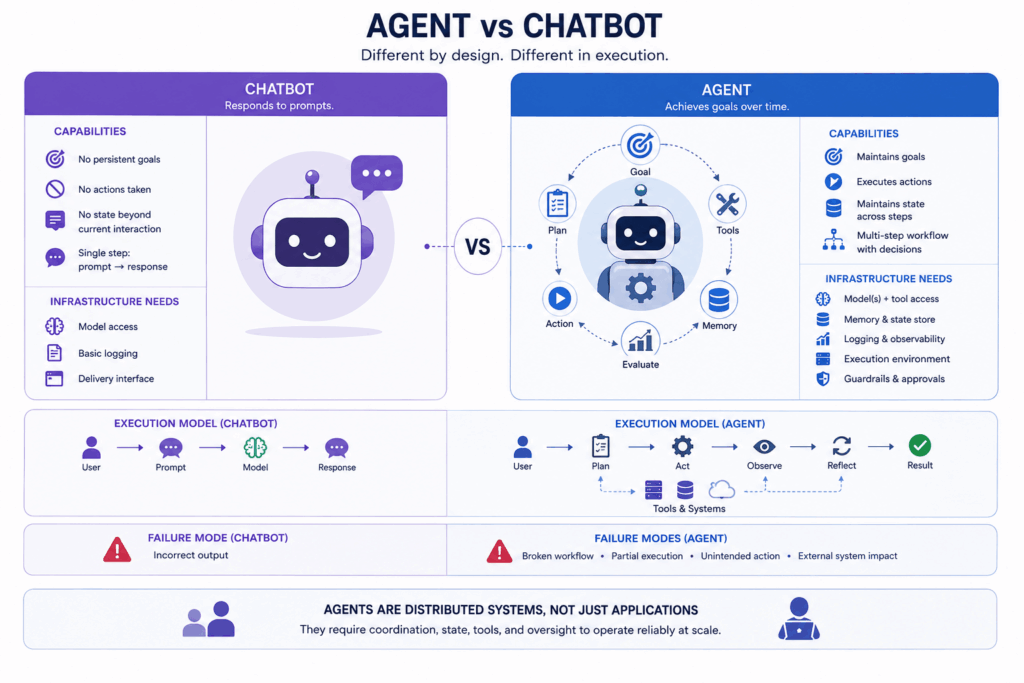
A chatbot processes a prompt and returns a response. It retains no goals, executes no actions, and manages no state beyond the current interaction. Its infrastructure needs are narrow: model access, basic logging and a delivery interface.
An agent operates across time. It maintains context, decomposes tasks, selects tools, executes actions and evaluates outcomes. A single task might involve interacting with multiple systems in sequence, making decisions at each step before producing a final result. That introduces persistent state and the need for execution oversight.
In practice, agents behave less like applications and more like distributed systems. They demand coordination between models, memory stores, tool interfaces and execution environments. When something goes wrong, it looks like a partial execution or an unintended action in a production system.
The core layers of AI agent infrastructure
Agent infrastructure breaks down into six interconnected layers. Most production failures occur at the boundaries between them, where assumptions about state, permissions or system behaviour turn out to be wrong.
The model layer provides reasoning and generation capability. Foundation models from OpenAI, Anthropic, Meta (Llama), or Mistral form the base. Model choice affects latency, cost, context window and reasoning quality. Enterprise deployments are increasingly hosting models internally on dedicated GPU infrastructure rather than calling external APIs, particularly when agent workflows touch sensitive data.
The orchestration layer governs task decomposition and execution flow. This layer shapes agent behaviour more than the model itself. Several frameworks now provide scaffolding for multi-step workflows with branching logic, error handling, and human-in-the-loop checkpoints:
- LangChain and LangGraph for chain-of-thought and graph-based workflows
- Microsoft AutoGen for multi-agent conversation patterns
- CrewAI for role-based agent collaboration
- Semantic Kernel for enterprise integration with Microsoft ecosystems
The memory layer combines short-term context with long-term knowledge. Prompt-level context windows handle immediate conversation state, while persistent storage systems provide the deeper knowledge base:
- Pinecone, Weaviate, Qdrant, and ChromaDB for embedding storage and retrieval-augmented generation (RAG)
- Structured data stores and graph databases for factual grounding
- Redis or similar systems for session state across multi-step interactions
The tooling layer connects the agent to the external world: APIs, internal software systems, databases, automation interfaces. Without it, an agent can reason but cannot act. Tool integration is where most of the real engineering complexity lives in enterprise deployments, especially when connecting to systems that were never designed for autonomous interaction.
The execution environment is where actions actually take place. It must be isolated and controlled, with full observability, particularly in enterprise settings. Containerised runtimes orchestrated through Kubernetes provide the isolation layer, with permission-scoped execution and comprehensive audit logging as baseline requirements.
The governance layer enforces permissions and ensures compliance with organisational policies. It determines what an agent is allowed to do, what requires human approval and how actions are logged for audit.
Observability for agent systems
Agent monitoring is a distinct discipline from traditional AI model monitoring. A conventional inference endpoint either returns a prediction or it fails. An agent executes multi-step workflows where failure can be partial or entirely invisible until downstream consequences surface.
Effective observability means tracing entire task execution chains, not just individual model calls. Which tools were invoked, in what order, what data was accessed at each step, whether the agent deviated from its planned path, how long each step took.
Agents also produce failure patterns that traditional monitoring was never built to catch: stuck loops, redundant API calls, escalating retry behaviour that burns through compute without producing results.
This observability layer cuts across the governance and execution layers and becomes increasingly critical as deployments scale from single-task pilots to multi-agent production systems.
Enterprise AI Agent Platforms
As the complexity of assembling agent infrastructure from individual components becomes clear, organisations are turning to enterprise AI agent platforms that bundle the layers described above into managed environments.
Microsoft Copilot Studio, Google Vertex AI Agent Builder, and Amazon Bedrock Agents each provide integrated orchestration, model access, tool integration and monitoring. The appeal is speed. Teams can move from concept to working agent without building every foundational layer themselves.
Flexibility is what you give up. Platform-level decisions constrain how agents can be designed and how deeply they integrate with internal systems. Those constraints become more visible as requirements get more specific.
Enterprise platforms are rarely the final state. They work as a starting point, with organisations extending or replacing components as their agent deployments mature. Most enterprises end up with a hybrid architecture: platform capabilities combined with custom-built orchestration and integration layers tailored to their specific workflows.
Running agents on private cloud infrastructure
For organisations handling sensitive data or operating in regulated industries, where agents run matters as much as how they are built. Running agents on a private cloud is often the primary choice.
Private cloud deployments keep models and data within controlled infrastructure, reducing exposure to external services and aligning with data sovereignty requirements. When agents interact with internal databases, customer records or proprietary systems, keeping the entire execution chain within a controlled perimeter is frequently a regulatory necessity.
The operational burden is real. The organisation takes on responsibility for provisioning GPU compute (typically NVIDIA H100 or A100 accelerators for model serving), managing model deployments, scaling workloads and maintaining system reliability.
Agent workloads are inherently less predictable than traditional inference. For instance, a single task might trigger multiple model calls or state updates in sequence. Capacity planning for that kind of variable demand requires infrastructure that handles bursts without wasting resources during quieter periods.
Hybrid architectures have become the norm. Critical agent workloads touching sensitive data run on private infrastructure. Less sensitive operations use managed cloud services.
SkyBiometry’s managed GPU services are built for this model: dedicated compute backed by a dedicated AI engineer who handles the infrastructure complexity, with the operational support of a fully managed platform.
NemoClaw: NVIDIA’s enterprise agent stack
Vertically integrated solutions are emerging as agent infrastructure grows more complex. NemoClaw, NVIDIA’s enterprise agent stack, is one of the most significant.
NemoClaw brings together NVIDIA’s NeMo framework for model development, NIMs (NVIDIA Inference Microservices) for optimised serving and NeMo Guardrails for governance and safety. Seeing as NVIDIA controls both the hardware (GPUs, networking, DGX systems) and the software (training, optimisation, inference, safety), performance can be optimised across the full stack in ways that disaggregated approaches struggle to match.
What does that look like in practice?
– An organisation deploys a multi-agent workflow where each agent runs on optimised inference endpoints through NIMs.
– Guardrailled tool use enforced by NeMo Guardrails
– These all execute on DGX infrastructure tuned for the sustained, variable compute that agent workloads demand.
– Model serving, governance and hardware operate as a single designed system rather than a collection of integrated parts.
For organisations already running on NVIDIA GPU infrastructure, NemoClaw provides a well-integrated path to production agent deployments. For others, it raises legitimate questions about vendor dependency and long-term flexibility.
OpenClaw: the open-source route in
OpenClaw takes the opposite approach. With over 327,000 GitHub stars and a rapidly growing community, it has become one of the most established open-source AI assistant projects available.
OpenClaw provides building blocks for orchestration, memory management, and tool integration without imposing a unified platform. It connects to the communication channels teams already use: Slack, Microsoft Teams, Discord, WhatsApp, Telegram, Google Chat.
It coordinates across multiple agents, executes tasks, browses the web and interacts with external systems. Critically, it runs on your own infrastructure so data never leaves your controlled environment.
Control is the advantage. Every layer can be customised and inspected, with every decision fully auditable.
Complexity is the cost. Self-hosting OpenClaw at enterprise scale means GPU provisioning for model serving, secure sandboxed execution environments, integration with enterprise identity and access management and ongoing operational maintenance. These are infrastructure challenges that go well beyond installing the software.
SkyBiometry operates as an OpenClaw deployment partner, handling the underlying GPU infrastructure, security configuration, and enterprise integration so that organisations can adopt OpenClaw without building the stack from scratch.
Check out our article on how you can begin using OpenClaw for your business.
Sandboxing for enterprise pilots
Agent systems act on real systems. That introduces risk that traditional AI deployments simply do not carry, especially during early deployment when agent behaviour is still being validated.
Sandboxed environments isolate the agent from production systems while allowing it to operate in a controlled setting. Actions can be monitored and restricted, with changes reversible if something goes wrong.
Effective sandboxing for enterprise agent deployments includes:
- Network isolation from production databases and services
- Permission-scoped execution that limits what the agent can read, write, and modify
- Comprehensive logging of every action, tool call, and decision point
- Approval workflows that route high-risk actions to human reviewers before execution
- Rollback mechanisms that can reverse unintended changes
Sandboxing does not end when the pilot does. Even in production, certain actions may be permanently routed through controlled environments or require human approval. The sandbox becomes a permanent part of the governance layer.
Integrating agents with legacy systems
An agent’s effectiveness comes down to what it can act on. For most enterprises, that means interacting with existing software environments that were never designed for autonomous interaction. Legacy integration is one of the hardest and most consequential aspects of any agent deployment.
Legacy systems often lack modern APIs and run on inconsistent data structures. In turn, these enforce access controls that predate the concept of non-human operators. Agents have to navigate these constraints while remaining reliable and auditable.
Intermediary layers typically help connect the two: API wrappers, screen-scraping bridges, database connectors, message queue integrations.
The Model Context Protocol (MCP), developed by Anthropic as an open standard for connecting AI systems to external tools and data sources, is beginning to simplify this work. MCP is still early in its adoption cycle, but it is gaining traction across major agent frameworks as a consistent interface for agent-to-system communication.
Integration quality determines practical value. A highly capable model with limited system access delivers little impact. A moderately capable model with deep integration into core business systems can reshape how an organisation operates.
What comes next?
AI agents represent a movement toward systems that act rather than respond. Supporting them requires infrastructure that brings models, orchestration, memory, execution and governance together into a system that is coherent and controllable.
The gap between a promising agent demo and a production system that reliably executes business workflows comes down to infrastructure. The organisations that recognise this early are the ones that will move beyond experimentation.
If your enterprise is building or evaluating AI agent deployments, SkyBiometry provides the underlying infrastructure: AI cloud and managed GPU services with dedicated AI engineering support, purpose-built for the complex compute workloads that agent systems demand.
We also work as a deployment partner for OpenClaw, handling the infrastructure and integration complexity so your team can focus on agent logic and business workflows.
If you require these services or have any questions relating to the content covered, please get in touch with our team.